Documented media mentions
18 English-language online reports, 2 English print reports and 17 Urdu print reports recorded in the completion report.
Ease of Doing Business in Pakistan
Through the six-month #UnlockPakBusiness initiative, Freedom Gate Prosperity brought business voices, research and policy dialogue together to advance a simpler, more enabling environment for entrepreneurs.
18 English-language online reports, 2 English print reports and 17 Urdu print reports recorded in the completion report.
A dedicated brief translates business consultations into practical proposals for simpler, coordinated compliance.
Formal policy submissions to FBR, SECP, and the Ministry of Finance and Revenue, dated 16 July 2026.
Source: FGP’s project completion report submitted to Atlas Network on 21 July 2026.
For small businesses, navigating complex requirements can take time and resources away from growth. FGP’s initiative focused on bringing these concerns into public discussion and developing practical proposals for a more accessible business environment.
The project connected economic reform with wider opportunity for small traders, young entrepreneurs and women, placing their participation at the heart of the conversation.
The project combined stakeholder engagement, policy development and public communication. Each strand reinforced the others: business experience informed recommendations, and dialogue and media outreach carried those proposals to wider audiences.
Consultations with ICSTSI, business leaders, entrepreneurs and policy voices identified practical barriers: repeated registrations, duplicated documentation, disconnected systems and overlapping compliance requirements.
FGP translated these experiences into an agenda for transparent, predictable and digitally enabled compliance. This helped connect the concerns of small traders with wider questions of investment, formalization and economic participation.
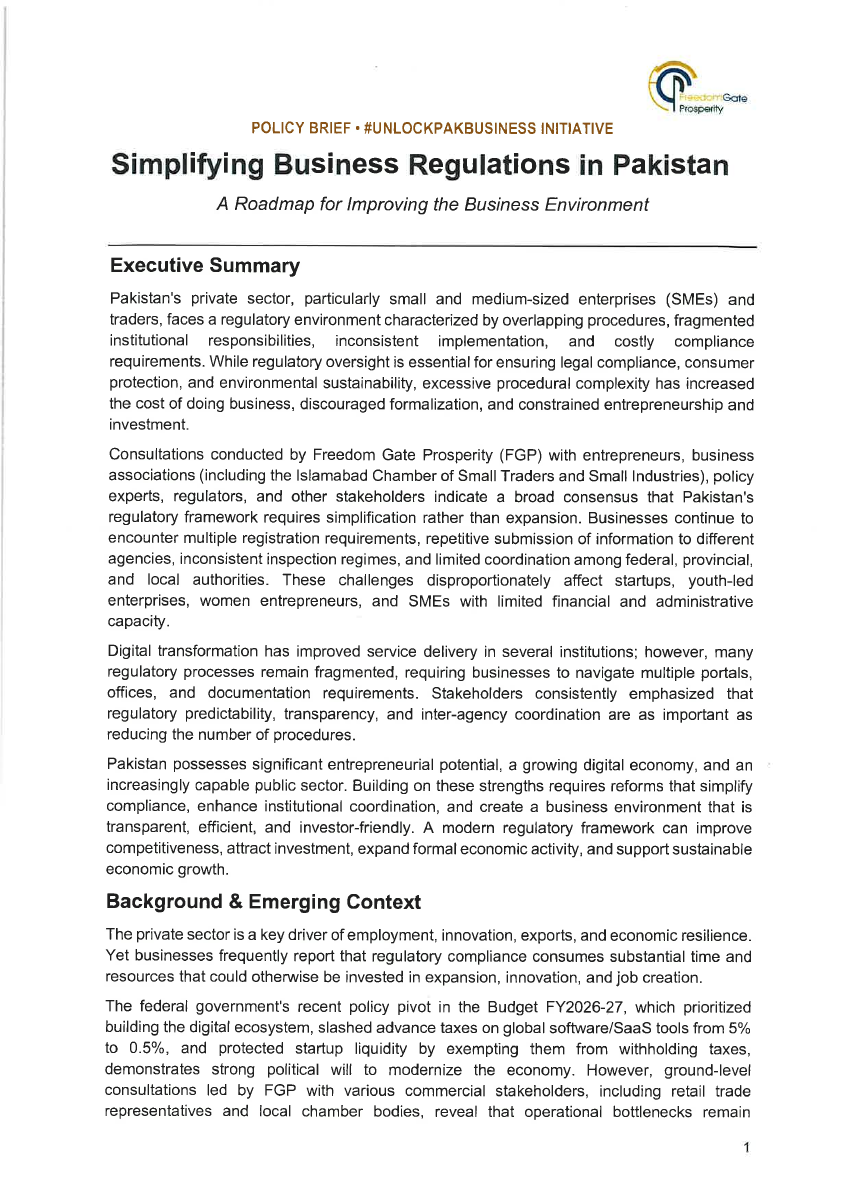
The brief, issued on 16 July 2026, brought consultation findings into a structured roadmap. Its ten recommendations cover digital integration, regulatory simplification, coordination, inspection reform and institutional capacity.
Three full-length dialogues and four short campaign clips brought business and stakeholder perspectives to public audiences. The conversations linked regulatory reform with youth enterprise, women’s participation, skills and SME growth.
Media outreach disseminated the project’s messages and recommendations. The completion report records 37 distinct media mentions across English online reporting, English print and Urdu print coverage.
Formal submissions addressed FBR, SECP, and the Ministry of Finance and Revenue on 16 July 2026, requesting technical focal persons and follow-up presentations to continue policy engagement.
Selected coverage already published on the FGP website provides a record of the consultations and public discussions.
A consultative meeting on ease-of-doing-business reforms, compliance and opportunities for small traders.
View consultation coverage →A discussion on reducing business friction, supporting entrepreneurship and expanding formal economic participation.
View discussion coverage →Business leaders and experts called for reforms to ease compliance and reduce barriers facing entrepreneurs.
View reform dialogue coverage →These full-length discussions extend the project’s consultation and public education work. Chamber leaders explain the barriers facing enterprises and offer proposals for a more enabling business environment.
Sheikh Amir Waheed · Former President, Islamabad Chamber of Commerce & Industry
Hosted by Urooj Raza Sayyami
The conversation connects investor confidence with predictable, respectful administration and a tax system that helps enterprises grow.
Nasir M. Qureshi · ICCI President at the time of the dialogue
Hosted by Urooj Raza Sayyami
This discussion examines policy uncertainty, the pressures facing manufacturers and the need to connect education with employment and enterprise.
Awais Satti · President, Islamabad Chamber of Small Traders and Small Industries
A trader’s perspective on navigating licensing, financing, inspections and digital compliance, with practical proposals grounded in everyday business experience.
Episode takeaways summarize the speakers’ perspectives and proposals. They are not statements of enacted policy or independent verification of every claim made during a discussion.
Short videos make the project’s themes accessible through focused contributions on business planning, women’s economic participation, vocational skills and simpler public services.
Moon Jaan
The clip connects careful business planning with the practical difficulties of documenting purchases from small, rural and home-based suppliers.
Dr. Rakhshinda Perveen
This contribution highlights the social and administrative barriers facing self-made women and the importance of hearing grassroots voices in policymaking.
Amjad Khan
The discussion links practical skills with enterprise creation and the potential for digital tools to connect businesses with wider markets.
Sher Muhammad
This contribution argues for enterprise education and coordinated public services that make it easier for young people to start businesses.
A Roadmap for Improving the Business Environment
The project’s policy brief brings together proposals to inform discussion on a more enabling business environment. It is a resource for policymakers, business associations, researchers and development partners interested in regulatory reform.
Issued 16 July 2026 · Four-page policy brief · PDF
The proposed roadmap focuses on smart regulation: transparent, proportionate and coordinated procedures that support enterprise while safeguarding the public interest.
A unified interface for registrations, licensing, renewals and compliance reporting, connecting authorized institutions and reducing repeated submissions.
A single business identification number recognized across government entities to improve consistency and reduce repeated registration.
Identify outdated, overlapping and low-value requirements; remove duplicate approvals while maintaining appropriate safeguards.
Publish consistent forms, documentation requirements, operating procedures and service timelines to reduce uncertainty.
Coordinate inspections and focus resources on higher-risk sectors and poor compliance records, reducing unnecessary disruption.
Harmonize requirements and implementation across federal, provincial and local bodies through formal coordination mechanisms.
Publish procedures, fees, timelines and appeal routes, and enable electronic application tracking and status updates.
Create structured, recurring consultation with chambers, SMEs, industry associations, professional bodies and civil society.
Assess the likely economic, administrative and compliance effects of significant new business regulations before implementation.
Invest in staff training, digital systems, process improvement and performance monitoring so reforms can be implemented consistently.
The completed project brought business concerns into policy dialogue, produced a dedicated policy brief and helped sustain public attention on the need for simpler regulations. These outputs provide a foundation for further engagement, research and collaboration.
Implementation status: The advocacy project is completed. The proposed Digital Compliance Gateway remains a policy framework; an operational platform and a signed FBR–SECP adoption agreement had not been secured by the reporting date. Government engagement and adoption remain areas for follow-up.
FGP’s continuing interest is to help turn dialogue into practical improvements through cooperation with business associations, policymakers and development partners.
The completion report identifies a trust gap around digital compliance. Small retailers need to understand how a new system will help them, with clear information, proportionate requirements and support that reflects their administrative capacity.
Moving separate procedures online does not by itself eliminate duplication. The project’s proposed gateway depends on institutions agreeing how to share information, align requirements and provide a coherent service.
The policy brief and recorded discussions remain resources for follow-up. Further progress requires sustained institutional dialogue, technical review, business participation and evidence of changes in actual compliance experiences.
What remains to be done: By the reporting date, the original targets for petition endorsements, verified digital reach, direct senior-level FBR/SECP meetings and a signed public adoption agreement had not been fully achieved. FGP’s next steps are to build on the documented work and continue engagement on the reform agenda.
We welcome conversations with donors, foundations, researchers and business associations interested in regulatory reform, entrepreneurship and inclusive prosperity in Pakistan.